Jump to navigation
Sign Up to ReceiveQS e-Guides!Sign up for free
It's a small nation nestled at the gateway between northern and western Europe, but as our guide explains, Denmark is a heavyweight study destination.
Vikings, Hamlet, existential angst (courtesy of Søren Kierkegaard) – many of the things that we associate with the nation are quite gloomy.
But a far more fitting cultural ambassador for the modern nation is the world’s most famous brand of brightly colored building block. (Yes, we’re talking about Lego.)
Why? Well, Denmark is actually one of the world’s happiest countries. And there is a lot to be happy about. It is an affluent nation with high wealth equality, it enjoys some of the world’s highest levels of press freedom and gender equality, and it is rich in terms of arts and culture.
The world famous Roskilde music festival, Noma (crowned the best restaurant in the world for the past three years running) and smash hit television series The Killing are among its better known cultural establishments.
No wonder Danes have an untranslatable word for a sense of cosiness and contentment (hygge).
There’s also a lot to be happy about when it comes to universities too. Five of the country’s eight universities proper make the top 400 of the 2012/13 QS World University Rankings, with the University of Copenhagen leading the way at 51.
Tuition is free for students from the EU and certainly not extravagantly high for those from further afield, and many courses are taught in English (as in other Nordic countries, civilian Danes generally speak quite good English too).
This proved to be a combination that 15,807 full degree and 8,678 exchange students could not turn down in the 2009-10 academic year. And you could be joining them – just remember to wrap up warm!
Search universities in Denmark >
Find out what it's like to be a student in some of Denmark's major cities...
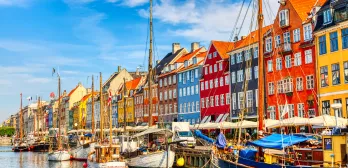
Denmark’s capital city is one of the most celebrated cities in Europe – if not the world. The heady combination of romantic spires and edgy new architecture, the vibrant and colourful cultural scene, the innumerable cafés and bars, and the consistently high quality of life enjoyed by its residents probably all have something to do with this.
But, like all great cities it’s all really down to a certain je ne sais quoi - you’ll just have to visit to find out! It’s not the cheapest place in the world to study, but neither is London or Paris.
As well as the University of Copenhagen, the country’s oldest and most prestigious university (ranked 51 in the QS World University Rankings), Copenhagen is also home to the Technical University of Denmark, ranked 132, the Copenhagen Business School and the IT University of Copenhagen.
See where Copenhagen ranks in the QS Best Student Cities >
Aarhus, a port town located on the country’s main peninsula, is Denmark’s second city and is home to the country’s second highest ranked university, Aarhus University; 89 in the 2012/13 QS World University Rankings.
Like Copenhagen, it has a rich history and a stunning historical quarter – including not one but two 13th century cathedrals – as well as a rich cultural scene and plenty of nightlife, courtesy of its large student population. Aarhus can lay claim to the status of happiest city in the world - the conclusion of lifelong research by National Geographic’s Dan Buettner.
Located on the island of Funen, which sits between main peninsula Jutland and largest island Zealand, Odense is Denmark’s third most populous city. It is noteworthy for being the birthplace of Hans Christian Andersen. It is also rich with Viking era history; you can see the skeleton of Saint Canute – the country’s patron saint – on display in the city’s historic cathedral.
University-wise, Odense is the location of the main campus of the University of Southern Denmark – ranked 318 in the 2012/13 QS World University Rankings, and resultantly this relatively small city is given an injection of life by the large student population.
An industrial city towards the north of Jutland, Aalborg is home to Aalborg University, which is ranked 352= in the 2012/13 QS World University Rankings. As you would expect from a large Danish city, it has a lot of well preserved historical architecture, but one of Aalborg’s main draws is Jomfru Ane Gade – a long street which is the center of the city’s café culture and nightlife.
It is also home to the largest carnival in Scandinavia, which traditionally occurs towards the end of May. The city’s waterfront is currently enjoying a long term regeneration and rejuvenation project.
Top ten things to do while studying in Denmark >
Denmark is part of the European Union. Therefore, as is standard, if you are from anywhere else in the EU/EEA (or Switzerland) you will be treated almost exactly the same as a local student. This means that university is free at all levels. If you are from outside the EU/EEA, you will be required to pay fees. In 2010, these were set at an average of US$18,305.
Universities are in charge of their own admissions, so apply directly. Various online resources (see below) are available, so you can find out what your secondary qualifications equate to in the Danish system; depending on your country of origin and grades a supplementary year may be required.
You’ll obviously need to prove you are fluent in the language of tuition, with the level depending on the course and university to which you are applying – as ever, check before you commit to anything.
Visa requirements also vary according to whether of not you are from an EU/EEA country. Citizens of Nordic countries are treated as exactly as if they were Danish citizens.
Find your perfect study destination.
Universities in the USUniversities in the UKUniversities in AsiaUniversities in EuropeUniversities in Latin America
The top universities worldwide, ranked by subject.
The world’s top universities – overall, by subject and by region
Meet university admissions directors from around the world, at a QS event near you
QS Stars is an in-depth rating system for universities
Admissions, finance and careers, lifestyle and news.
Find the university that best fits your interests and career plans